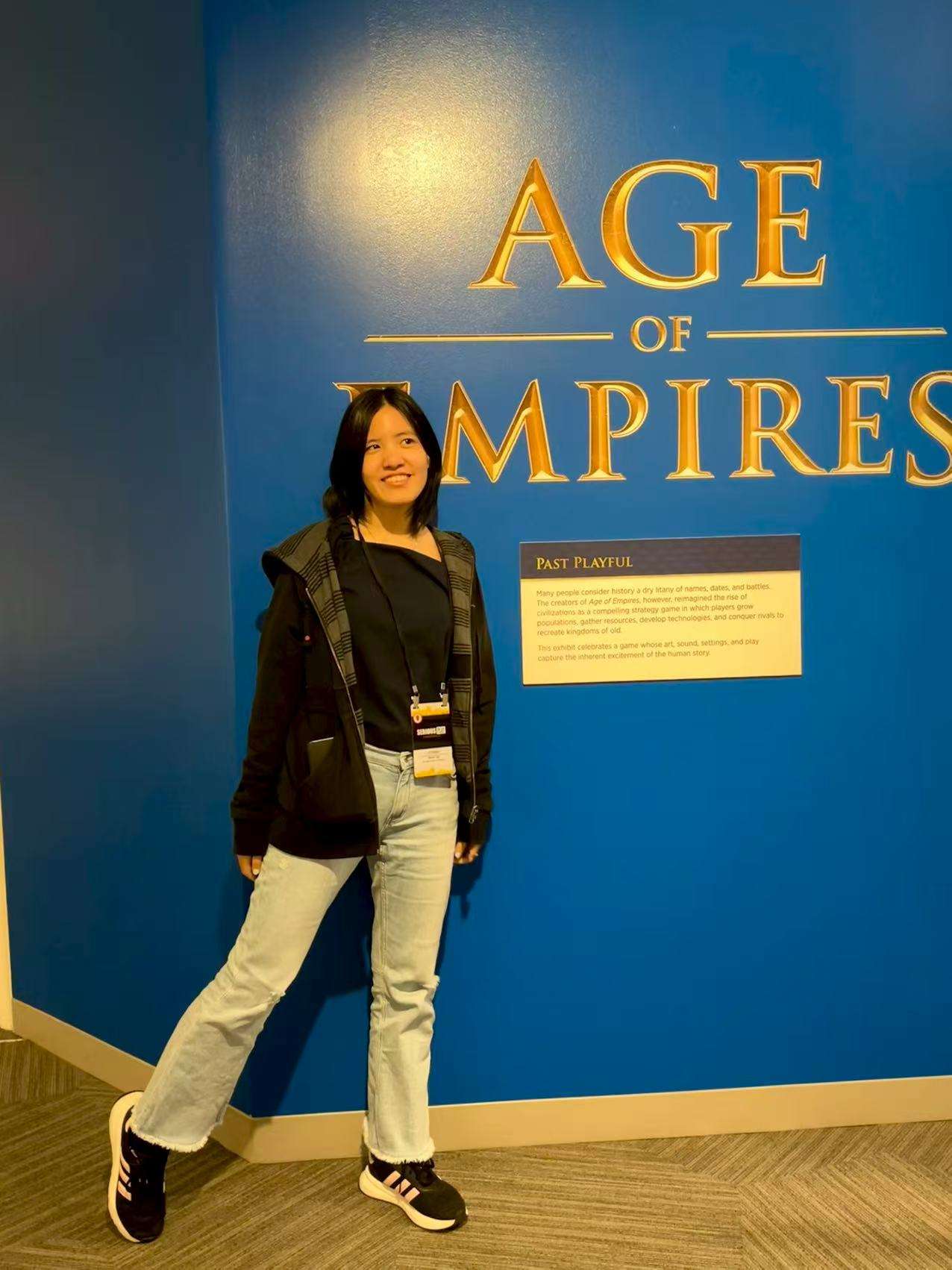
Hi, I'm Winnie
I'm a game and interactive experience designer who is happiest when the answer is not obvious yet.
A lot of my work begins with an unfamiliar medium or a difficult design question. I've explored four phones as one shared game space, haptics as part of emotional storytelling, interaction design for a 270-degree immersive environment, and games that help players practice metacognitive awareness. I like understanding why existing conventions work, deciding which assumptions are worth keeping, and testing what happens when we push beyond them.
My technical foundation gives me a lot of freedom in that process. I hold a BS in Applied and Computational Mathematical Sciences, focused on Discrete Math and Algorithms, from the University of Washington. I am comfortable learning new tools and systems as a project demands them, whether that means an engine workflow, hardware platform, scripting system, research method, or production pipeline.
My minor in Dance trained a different muscle: timing, embodiment, emotion, and attention to how an experience feels. Together, those backgrounds make me comfortable moving between systems thinking and player experience, technical constraints and creative goals.
I also care deeply about the why behind a design. I tend to ask what a player needs to perceive, feel, or understand before deciding what a mechanic should be. Prototypes and playtests keep that thinking grounded: I like turning a difficult question into something testable, seeing where my assumptions break, and using that evidence to decide what to build next.
I'm currently a graduate student at Carnegie Mellon University's Entertainment Technology Center, working across game design, technical design, narrative, art, engineering, research, and production. My interests tend to cross disciplines, and I've learned to treat that range as a design tool.